
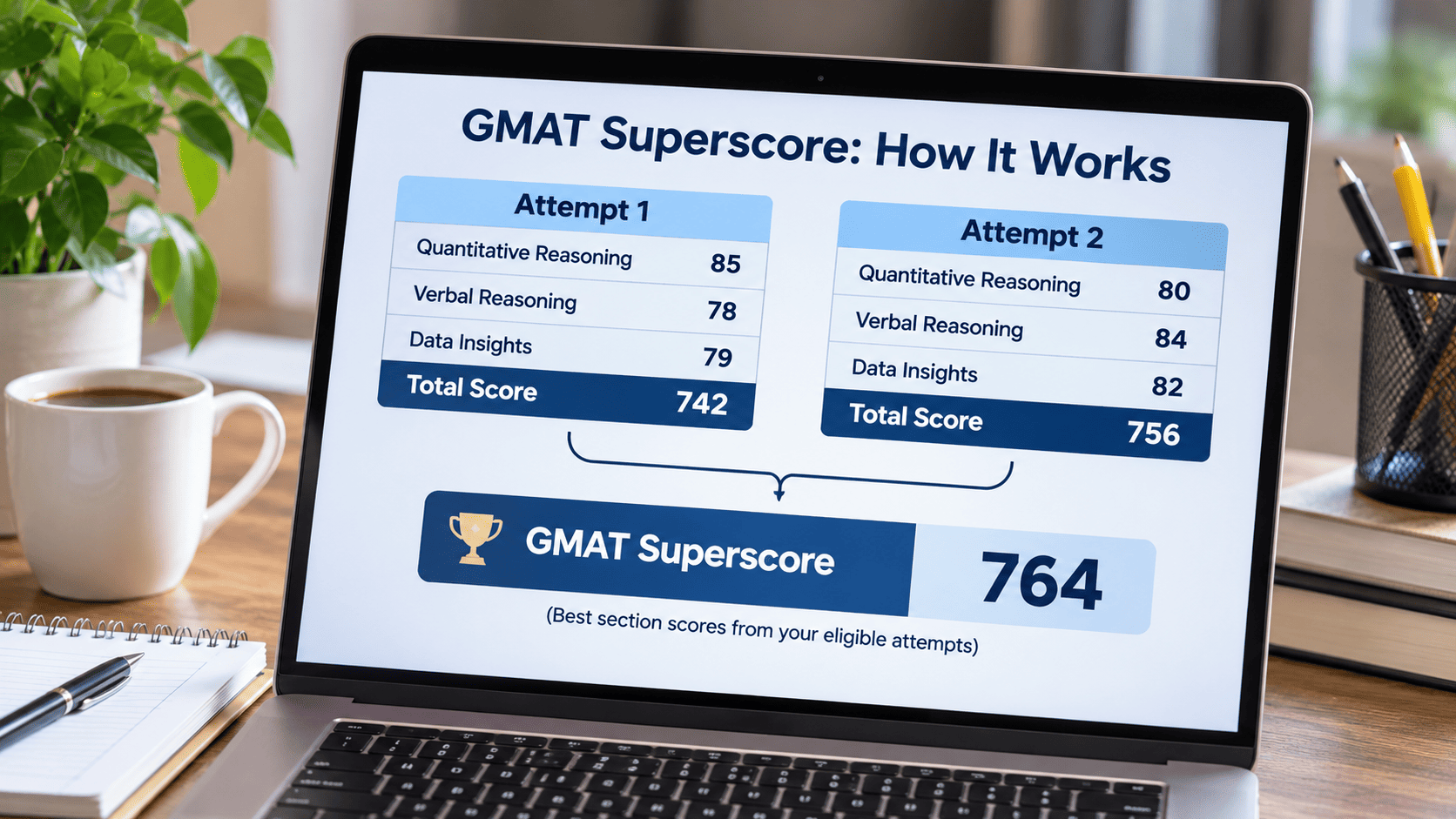
Until recently, a GMAT retake meant reporting a single total score and hoping your second attempt beat your first. GMAC has now added the GMAT Superscore, a feature introduced in 2026 that combines your best Quantitative Reasoning, Verbal Reasoning, and Data Insights results from different eligible attempts into one extra reported score.
Understanding this change can help you plan your GMAT preparation, retakes, and 2027 MBA applications.
What Is the New GMAT Superscore?
The GMAT Superscore combines your highest Quantitative Reasoning, Verbal Reasoning, and Data Insights scores from eligible exam attempts into one additional total score. Announced by GMAC in June 2026, it appears alongside your individual exam results rather than replacing them.
A short example shows the method. The scores below are hypothetical.
|
GMAT Section |
Attempt 1 |
Attempt 2 |
Best Score Used |
|
Quantitative Reasoning |
85 |
80 |
85 |
|
Verbal Reasoning |
78 |
84 |
84 |
|
Data Insights |
79 |
82 |
82 |
Here, your first attempt supplies the 85 in quantitative reasoning, and your second supplies the 84 in verbal reasoning and the 82 in data insights. Together they form one total on the 205 to 805 scale. Business schools receive the superscore alongside the relevant section scores and their associated test dates. The original exam results remain part of the candidate's score history.
GMAC calculates the superscore for you, so there is nothing to select or submit. Only valid attempts from the latest GMAT edition are eligible. Expired scores, cancelled scores, and scores from the older GMAT 10th Edition are excluded.
How Will GMAT Superscore Affect MBA Applications in 2027?
In practice, the GMAT Superscore adds one combined score to your report after a retake. It affects your 2027 application only as far as each school chooses to use it, and many programmes have not yet said whether they will.
Business Schools Can See More Context
Admissions teams get the superscore next to your original section and total scores, never in place of them. If your second sitting went better in two sections, they can see that shift for themselves. It helps most when your results swing from one attempt to the next.
University Policies Still Differ
Some programmes may weigh the combined score. Others may keep going by your best total from a single sitting, as before. You can’t tell which group your shortlist falls into without checking.
So before you book a retake, open the admissions page for each programme you’re considering. If the page says nothing, send the team a short email and ask.
Your Overall Application Still Matters
A higher GMAT result can support your candidacy, but universities also review your academic background, professional experience, essays, recommendations, and career goals. The superscore is additional information, not a substitute for a well-prepared application.
Also Read: How Important Is GMAT in Business School Admission?
Should You Change Your GMAT Preparation Strategy?
Yes, but not by focusing exclusively on one section. Use your previous score reports to identify weaker areas and adjust your preparation accordingly. Continue practising all three sections because each exam attempt produces an individual total score that schools can consider alongside your superscore.
Start With a Diagnostic Assessment
A diagnostic test establishes your baseline score in each section. It also shows whether your main challenge is conceptual understanding, timing, question selection, or stamina.
That distinction matters because a timing problem in data insights needs different practice from a gap in critical-reasoning skills.
Review Errors After Every Practice Set
Sort your mistakes into categories such as calculation errors, misread questions, poor pacing, or unfamiliar question types. This review helps you decide what to study next.
Keep a simple error log and revisit it weekly. Patterns usually appear quickly, and those patterns should determine your next practice focus.
Use Full-Length Mock Tests
Continue practising all three sections, even if one area needs more attention. Full-length mock tests show whether you can manage the complete two-hour and 15-minute exam under realistic conditions.
If your mock scores become more consistent and your timing improves, you will have stronger evidence that you are ready for the actual exam.
Also Read: Common GMAT Mistakes and Tips to Avoid
Is Retaking the GMAT More Beneficial With Superscoring?
Sometimes, yes. A retake helps most when one section is the reason you are short of your target, because the superscore keeps your best result in each section. A weak data insights score can be rebuilt without putting a strong quantitative reasoning score from your first attempt at risk.
Know When a Retake Makes Sense
A score report can help candidates determine whether another attempt is worthwhile. For example, a student with 84 in Quantitative Reasoning, 83 in Verbal Reasoning, and 71 in Data Insights has a noticeable gap between sections. In this situation, reviewing the mistakes and taking a diagnostic test can help identify whether additional preparation in Data Insights could improve the overall result.
Understand the Retake Rules
GMAC sets a minimum of 16 calendar days between attempts and allows five sittings in any rolling 12-month period. The wait is rarely the real limit. Fees and preparation time matter more, so book the next date only when your practice tests show the weak section improving.
How Can GMAT Coaching Support Your 2027 MBA Preparation?
Structured GMAT coaching turns your diagnostic results into a study plan and helps you decide whether a retake is worthwhile. With the superscore in place, knowing which section deserves most of your time matters more than studying every section equally.
A review of previous score reports and diagnostic assessments can help candidates identify which sections require additional attention. This makes it easier to develop a preparation plan based on individual performance, available study time, and upcoming MBA application deadlines. That review decided whether they needed a retake or more practice first.
- The group course runs 76+ hours, with 36 in the classroom and 40 on practice tests.
- Individual coaching follows a custom study plan with flexible scheduling, which suits a full working week.
- Mock tests are proctored and use real GMAT questions, and a review after each one shows whether timing or accuracy is costing you points.
- Admissions guidance sets your exam date ahead of your MBA deadlines, with room for a second attempt if you need one.
If you are weighing GMAT coaching in Dubai, ask any centre for a diagnostic first, because it shows what your plan will cover.
Final Thoughts
The GMAT Superscore allows candidates to demonstrate their strongest performance across multiple exam attempts. For someone whose overall score was previously limited by one weaker section, an improvement in that area can now contribute to a higher combined score. A later improvement there can now count toward your combined total, even if the rest of that sitting went the same as before.
For 2027 admissions, treat the superscore as one part of a wider plan. Set a realistic target and prepare one section at a time. Review every mock test, then ask yourself a plain question: will another attempt actually fix something? Schools will still read your whole application, so let the superscore support it and do not rely on it alone.
